Book That Gig Audition Course - Lesson 1
From Preparation to Performance
“My approach is to look at the character’s world. Often, we get so locked into memorizing lines and practicing how we’re going to say those lines, when in reality the lines are just a symbol or representation of the person. I spend a lot of time getting into the character’s life. Every character has a point of view, so what informs this character’s point of view?”
Malcolm-Jamal Warner

The Audition!
We are now going to breakdown the audition process for film actors, highlighting the stages involved from preparation to performance. The audition process is a crucial aspect of an actor’s career, as it determines their potential involvement in a film project. By examining the various steps actors undertake, including script analysis, character development, audition techniques, and the performance itself, I’ll share with you the intricacies and challenges of the film audition process.
But before we do that, lets find a little inspiration from an iconic past audition to see that anyone can make their dreams come true if you just step out and give it a shot! It is from a different genre, but the reality is still the same. So, what made Simon Cowel look like this? A star can come from anywhere. Yes..
You can be the next big actor discovered!
Do you feel inspired to live your dream yet? Let's get to work!
Susan Boyle gained attention after her appearance on Britain’s Got Talent when she wowed the judges with her amazing, and very unexpected, audition. She sang the song “I Dreamed a Dream” and was immediately put through to the next level, thanks to her operatic voice. She continues to release music, with her most recent album being Ten. Her net worth is $40 million. Not bad for taking a chance and putting herself out there.
The film industry is a highly competitive field that demands talent, skill, and dedication from actors. The audition process serves as the gateway to potential roles in film projects. It is a rigorous and multifaceted process that requires thorough preparation, strategic execution, and a deep understanding of the character and script.
1. How to get an Audition
Before we cover what to do in an audition, you have to first GET an audition. Getting an audition opportunity as an actor requires a bunch of work beforehand to get to the audition room. Lets get to it!
Actor Training and Skill Development:
Before you can get an acting audition, you have to be ready for one! Make sure you are developing your acting skills by going through an actor training program like this one and taking acting classes. Continuous training will help you build a strong foundation and showcase your talent when you do get an audition. You only get 1 chance to make a first impression. Don’t waste it by seeking auditions before you have the skills and abilities to perform well in one. Nobody knows how to do open heart surgery from birth. It is a skill to learn. The same is true for acting. Learn your craft before you start your career!
Create a Strong Portfolio:
Self promotion may seem…well, selfish and self centered, but it is not! You are not going to be “Discovered” wandering through Walmart. You have to let the people who need actors know that you are out here and ready to be a part of their film, TV show, or commercial. Prepare a professional acting portfolio! We will cover this more thoroughly in The Professional Actor series later but we will cover the highlights now.
A Professional Headshot:
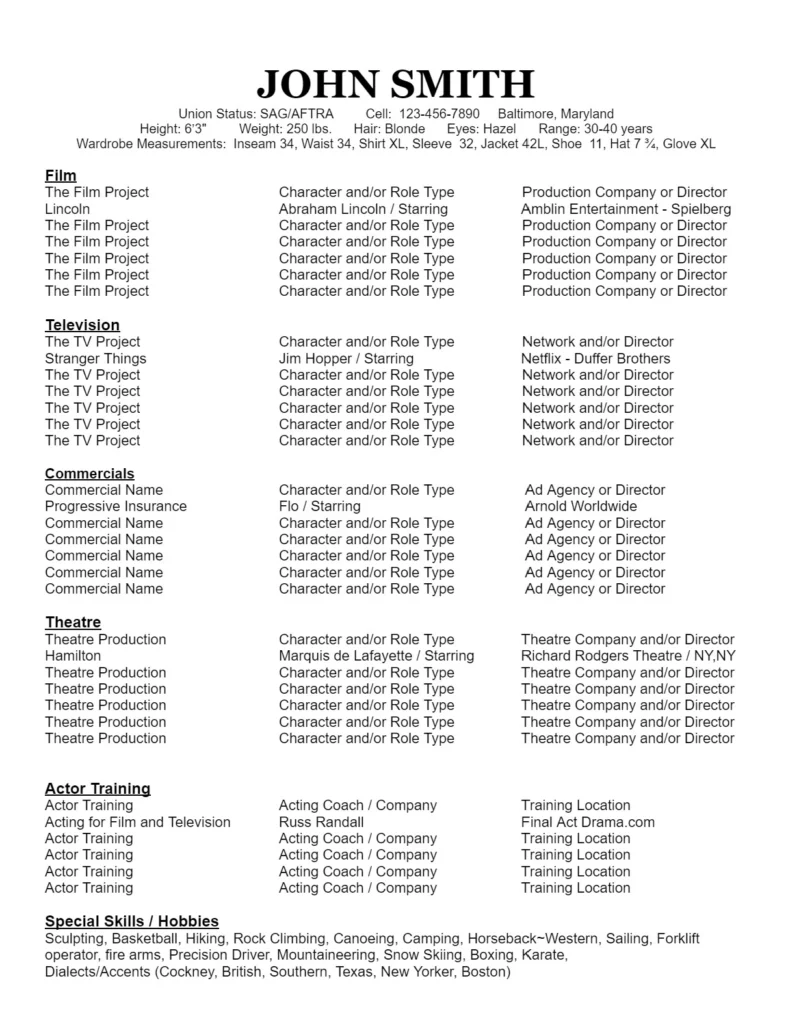
This is a package of photos taken by a professional photographer who knows how to take an ACTOR HEADSHOT. This is your most important marketing piece in your portfolio. Talent agents, managers, casting directors, and directors need to know what you look like. If you look like what they envision for a particular role, then they will look at your resume and consider giving you a shot to audition. If not, then they move on. Don’t take it personally. The audition process is very subjective.


An Industry Standard Actor resume:
So what goes on your resume? Not your job at McDonalds or your current job as a sales rep. Only projects or performances that you have been a part of that apply to your acting career. So, what if I don’t have any experience? No problem! Everyone starts at the beginning. Items that belong on a resume are:
Name
Cell Phone number
Email addressHometown, city and state
Union Status
Age Range
Height, Weight, Hair Color, Eye Color
Your clothing measurements
Film Credits
TV / Video Credits
Commercial Credits
Stage Production Credits
Actor Training courses and Special skills
An Actor’s Reel:
This is a video showreel showcasing your best performances from film and television. When you are a beginner, you won’t have one. Don’t sweat it! A solid headshot and resume will get your foot in the door for the level of roles you will be auditioning for. No, you won’t be the starring role of the next blockbuster film, but who is when they start acting.
The whole purpose for an Actor’s Portfolio is to convince those who are casting the acting roles for a project to give you a shot to audition! That’s it! Your whole marketing goal is to get an opportunity to show what you got as an actor. Once you get the audition, then it’s time to put that actor training to work.

Get an Agent or Manager:
Once you have an industry standard Headshot and Resume, consider seeking representation from a reputable talent agent or manager. They can help you find auditions and navigate the industry. Agents and managers typically know when films and TV shows are in development and pre-production, and when they are looking to cast roles. Contacting a Talent Agent or Manager to see if they will consider you for representation is a good next step. They will most likely want to see some sort of acting example. Having a solid film or TV monologue prepared is a good idea. I would also suggest having agents in different markets to spread the net wider in finding audition opportunities.
Networking:
Attend industry events, workshops, and networking sessions to connect with casting directors, producers, and other actors. Many introverts try avoiding this part at all cost. They just want to act. But the reality is…industry professionals need to know that you exist and that you are the solution to their casting need. Networking can lead to valuable contacts and audition opportunities. You have to be out in the traffic if you are going to be hit by a car! Get out there!
Union or Non-Union?
Many actors want to be a union actor with SAG-AFTRA (Screen Actors Guild – American Federation of Television and Radio Artists) if applicable in your country. There are benefits and drawbacks from union membership. Plus, you have to meet eligibility requirements before you are invited to join. This is a big step for an actor. Take your time, inform yourself, and make a decision that works best for your career. Membership can provide access to audition notices and other resources.
Audition Websites and Casting Calls
Use online platforms to find audition notices and submit yourself for consideration for roles. These online sites can be a valuable resource for projects that you would normally not know about. However, since they are a worldwide resource, everyone else has access to this information as well. These sites provide different levels of information and access. You can create a free profile with limited options or you can subscribe at a paid level for more access and profile options. Here are some sites:
www.Backstage.com
www.CastingNetworks.com
www.CastingWorkbook.com
www.ActorsAccess.com
www.Mandy.com
www.NYcastings.com
www.CentralCasting.com for background and extras
Stay Informed:
Keep an eye on casting calls, auditions, and open casting events through industry websites, social media, and entertainment news outlets. Stay connected with your state film office and those of surrounding states. Join actor groups on major social media sites to stay in the know of what production work is going on in your part of the country.
Be Persistent and Resilient:
Rejection is common in the acting industry. Stay positive, learn from each experience, and continue pursuing opportunities. EVERY actor goes through the experience of feeling like they are not talented enough, not tall enough, too tall, too big, too small, not pretty enough, too pretty, ahead of our time, behind our time, or whatever your head wants to tell you. You have to shut down the self-defeating thoughts and be persistent. Hollywood is full of stars that almost quit. “One more audition and then I am done!” Boom, they land their breakout role. You just never know.
Remember that getting auditions is a competitive process, and success may take time. Consistency, perseverance, and continuous improvement in your craft are essential to increasing your chances of landing auditions and eventually booking roles.
So now that you have done the preparation for your audition, that amazing email arrives to say, “Congratulations, you have been selected to audition for the <whatever> role! Here are the details.” Check your schedule and confirm your availability for the days they are holding auditions and confirm that you have accepted the audition opportunity and THANK THEM!
Now it’s time to get back to work.
2. Schedule your Audition
Coordinate your Appointment:
Make sure you coordinate with your agent or casting director to confirm TIME and LOCATION of your audition. Get the address of the audition location. Don’t assume you know where it is! Plug it into your GPS application and make sure you know where it is and how long it takes to get there. Get a phone number of the location where you will be auditioning in case you are running behind or get lost. You should get a confirmation email from the agent or casting director confirming your date, time, and location of your audition.
Get your “SIDES”:
Also, included in that confirmation email should be your “SIDES”. Sides are a portion of the script that you will be auditioning with. Make sure you know this term and don’t have a clueless look when you are asked, “Do you have your sides?” If it is a commercial, you should get the whole commercial, but if it is a film or TV show, you will only get a scene or two to prepare with.
3. Preparing for the Audition
Understanding the Script:
Once you are notified that you have an audition, get right to work on your preparation. Frequently, you will have short notice until the time of your audition so you need to fit your preparation in and around the rest of your life. Auditions rarely come at a convenient time, so accept that. Preparing early in the morning, late at night, using your audition app while driving are all options. One of the first steps in preparing for an audition is to thoroughly analyze the script or sides. This involves studying the plot as a whole, identifying the your character’s motivations, and understanding the story’s context. By gaining a deep understanding of the script, actors can bring authenticity and depth to their performance.
4. Researching the Character
After understanding the script, actors delve into researching the character they are auditioning for. This includes examining the character’s background, personality traits, relationships, and any specific physical or vocal attributes. Research allows actors to create a well-rounded and believable portrayal. Refer to Acting for Film and TV: Fundamentals Course, Section 7, Crafting Memorable Characters. Do the work described under Trait Analysis, Relationship Dynamics, Arc and Transformation, and Emotional Journey of your character. If you don’t have the full script, do your best to make informed decision on your character and fill in the blanks with your imagination based on the information that you have.
5. Building the Character
Be Persistent and Resilient:
Once the research is complete, actors begin building the character. Refer to Acting for Film and TV: Fundamentals Course, Section 7 and go through the Six steps to building a character. These 6 questions will help you define your character. We can also start finding connections between their own experiences and the character’s journey, exploring the character’s emotional range, and developing mannerisms and behaviors that align with the character’s personality. Building a strong character foundation is crucial for a compelling performance.
6. Memorizing the Lines
Memorizing lines is an essential part of the preparation process. Many beginning actors think that memorizing your lines is the finish line of the preparation for an audition or scene. No, No, No! Memorization is maybe the halfway point on our journey.
Read and analyze the script:
Before attempting to memorize lines, read the script thoroughly to understand the character’s motivations, emotions, and the overall story. This deep understanding will make it easier to connect with the lines and remember them.
Walk through your scene:
While we are working on our lines, it is helpful to walk through your scene as you imagine it might be when you get on set. By connecting certain lines to actions in the script, it helps us to associate those lines with those actions, thus helping with recall in the moment. Internalize the dialogue: Actors must internalize the dialogue to deliver a natural and authentic performance. Techniques such as repetition, visualization, and breaking down the lines into smaller segments can aid in effective memorization.
Record your lines:
In recent years, the use of rehearsal apps has become more frequent. By recording our character’s lines and the lines of everyone else in the scene, into the rehearsal app, we are able to play our lines over and and over until we have them down pat! Repetition , Repetition, Repetition! You can also remove your own lines and just have the other characters speak while you speak your lines.
Practicing with scene partners:
Rehearse with other actors if possible. Interacting with scene partners can help solidify your lines, work out kinks in your scene and improve your overall performance. Practicing under different circumstances, environments or situations can mimic the pressure of a performance and improve your ability to recall lines under stress.
Once you think you got it memorized…keep working on it:
Many of my students have their performance perfected on their own, but when they get to the moment where they need to perform, they lose it. There is a bunch of mental noise in our heads when we are performing. You need to learn how to shut it out and focus on your scene, your character, and the moment only. You will need to go through this process of memorization then performance, many times before you understand the level of preparation that you personally need to have an audition free of memory problems.
Remember that memorizing lines is a gradual process, and it’s normal to face challenges along the way. Patience and persistence are key to successfully memorizing a script. Additionally, each actor may have their own preferred methods, so feel free to experiment and find what works best for you.
When you have really short notice for an audition, there is a technique that I will cover below that will help you nail your audition even when you don’t have your lines memorized.
7. Dressing Appropriately
Research the Role:
Be sure you understand who your character is and seek information from your agent if you are unclear. If it is a commercial, research past commercials from this company to see what their style is and what previous actors wore in their commercials.
Look the part:
First impressions matter, and actors must dress appropriately for auditions. The attire should align with the character’s style and the tone of the project. If you are auditioning for the role of a slave, don’t wear a dress or suit and tie. Conversely, if you are auditioning for the role of a businessman or woman, don’t show up in a T-Shirt and shorts. Always dress with a hint of your character. You don’t need full blown wardrobe for a period piece (unless they ask for it). Producers, Directors, and Casting Directors need to envision you in this role. Look the part!
I remember an audition I went on for a spokesperson for a furniture store. I was wearing a suit and tie because that is what the previous spokesperson wore in the commercials. Just before I went into the audition room, the next actor to audition showed up. He was wearing a leather motorcycle jacket, blue jeans, a chain connecting his wallet, cowboy boots, and a T-shirt. I asked him what he was auditioning for, and he said the furniture spokesman. I thought, “You do you, Dude!” He didn’t get the gig.
No logos or Brand:
When wearing contemporary clothing for an audition. Don’t wear something with distinctive logos or branding on it. It is frowned upon.
Colors and Patterns:
When auditioning for any role, be sure to wear non-distracting colors and patterns. You are not looking for complements on your attire. You are looking for complements about your performance. Solid color shirts and pants are always good. Don’t wear black and white! It is difficult to light appropriately on camera.
Neat and Clean:
It is important to present oneself professionally and to pay attention to grooming and personal presentation. Regardless of your talent and abilities, you can at least be sure to be showered and well groomed. No one wants to work with a stinky actor! Also, make sure you are wearing clothes that are pressed and free of wrinkles or stains (unless it conflicts with your character’s look). If you don’t know how to iron clothing…LEARN!
8. Arrival at your Audition:
“You’re not going there to get a job. You’re going there to present what you do.” — Bryan Cranston
Be Professional, Prepared, and Punctual:
When you secure an audition, be professional and punctual. Follow all instructions provided by the casting director and present yourself in a positive and respectful manner. You should come in with your script/sides PRINTED OUT. Have your lines highlighted. You should also have 2 headshots and resumes. Also, leave any items you don’t need locked in your car.
Be 15 minutes early to your audition time:
If you can’t be on time for an audition, why would they think you would be on-time for a shoot day? Give yourself enough time to allot for traffic and other delays. If you are going to be late, make sure you call and notify them of when you expect to arrive.
Check in and verify what role you are reading for:
Most likely they are audition many people for many different roles. If you don’t verify what role you are auditioning for, you may get in the audition room and find that a mistake has been made and they sent you the wrong sides. (This has happened to be before.) When that happens you have no time to recover. If you discover the mistake at check-in, then you at least have 15 minutes to review the new role.
Headshots and resumes (2):
When you come to your audition, make sure you bring at least 2 headshots with your resume printed or stapled to the back. This is a huge marketing piece that shows you are a professional. The person leading the audition will most likely take notes on your headshot to keep for future reference. Why bring 2 headshots? Most casting directors are casting more than one project at a time. You may or may not work for this role, but they may have another project coming up that you would be perfect for as well. If they ask you for a second one, then you have one right there to give them and don’t have to mess with sending one to them.
“Slate” the Noun:
Get paper for and make your “Slate”. When you check in, they will most likely give you a blank sheet of paper and a marker to make your “Slate”. Your slate is a piece of white paper held in a landscape/horizontal position, with your First and Last name written neatly in big block letters taking up 2/3rds of the paper. The last 1/3rd should contain the name of your representation / agent for this project. It should look like this: You will use this in your audition. Hold tight…

9. The Waiting Room Experience
The waiting room can be a nerve-inducing environment, as actors may encounter other talented individuals vying for the same role. Actors should focus on staying calm, maintaining concentration, and avoiding comparison or self-doubt. Using the waiting time to mentally prepare and warm up can help actors feel more confident. Don’t get caught up in a bunch of chit chat with other actors.

Focus on reviewing your sides so that everything is fresh in your mind. Don’t arrive more than 15 minutes early if you can help it. The extra time will only serve to make you anxious.
10. Navigating the Audition Room:
Own the Room:
Your name has been called and you walk across the threshold of the door. THE AUDITION HAS BEGUN! From that very first moment, everyone in that room is thinking, “I hope this is the person for this role!” Be confident, and OWN THE ROOM! This is what actors do, they audition! They don’t get every job, but they audition! You should look at this room as home field advantage. They came to YOUR house! If that sounds arrogant, well maybe it is. But the fact is that every great actor has a bit of ego to them. We have to! We have to have that confidence in our preparation and ourselves that when that red light on the camera goes on and we hear the words “Action”, that we are comfortable with all the attention being on us. On a film set, you need to have the solid confidence in yourself that just before you hear “Action”, you can look at the director, give them a little wink as to say, “I got this!” If you can’t “Be” confident, then “Act” confident! You’re an actor right? Then, act like one!
Establishing Rapport with Casting Directors:
Building a rapport with casting directors is crucial during auditions. Actors should be friendly, respectful, and open to direction. Engaging in a brief conversation before the performance can help create a positive and memorable impression. Don’t drag it out too long. Make sure you know why you are there. It is also important to know that the people casting the project are rooting for you! They want you to knock it out of the park. Quick Tip: Don’t initiate a handshake at the audition. Most Casting Directors are germ-a-phobes. They will be auditioning a bunch of people that day. They don’t want to go through a bottle of hand sanitizer in the process.
“Would you like a headshot and Resume?”
This is your time to deliver your headshot and resume. Offer one to them. They will always take it.
Look for your Mark:
All auditions for film and television will be recorded on video. Look at where the camera is pointed. Somewhere in that direction will be two pieces of tape on the floor in the shape of a T. Put your feet on both sides of the vertical tape, and toes flush with the top. That is where the magic will happen for you.